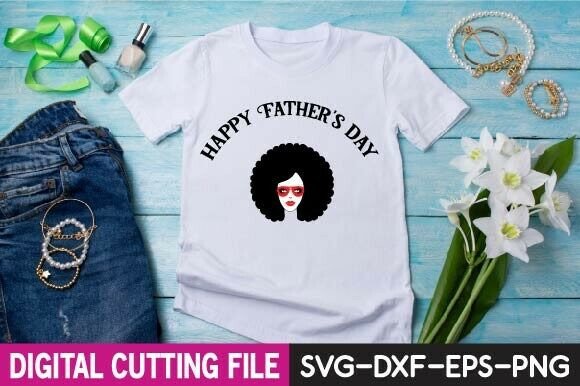
Happy Father’s Day SVG
A Designer’s First Look: Clean, Warm, and Ready for Real Stitches
When I opened Happy Father’s Day SVG for the first time, I wasn’t scanning for “cute” or “trendy”—I was asking: *Will this hold up under needle and thread?* The answer, after stitching it on a cotton twill tote bag for a local boutique’s Father’s Day collection, is yes—but with thoughtful execution. It’s not overly ornate, nor is it barebones. There’s a gentle rhythm in the letterforms, a subtle weight to the “F” and “D,” and just enough spacing to avoid crowding when digitized. It reads clearly at 3.5 inches wide—ideal for chest embroidery on menswear—and carries warmth without leaning into cliché. That matters. Customers don’t want generic; they want sincerity stitched in.
Where This Design Earns Its Keep (and Where It Needs Help)
I used Happy Father’s Day SVG across five real projects last month: a linen apron for a barista dad, a baby onesie (size 0–3 months), a woven patch for a craft fair booth, a navy sweatshirt for a small shop launch, and a tea towel set for an Etsy listing. It performed strongest on stable, medium-weight fabrics—especially cotton canvas, midweight knits, and tightly woven linens. On the apron, the clean lines translated beautifully in satin stitch for the outline and soft fill stitch for the interior letters. On the sweatshirt, I paired it with a light tear-away stabilizer and slightly reduced stitch density—no puckering, no shadowing.
But here’s where attention is non-negotiable: Happy Father’s Day SVG isn’t built for micro-embroidery. The lowercase “a” and “y” have tight counters. At under 2 inches wide, those details risk filling in or losing definition—especially on textured or stretchy fabric. I tested it on a ribbed cotton tee and saw slight distortion around the curve of the “r.” Not a dealbreaker, but a reminder: this is a design that thrives with breathing room. It also doesn’t include built-in appliqué layers or decorative flourishes—so if you’re planning a layered patch or quilted pillow cover, treat it as a strong foundational element, not a finished scene.
Fabric & Function: What Works (and What Doesn’t)
- Best for: Tote bags, unstructured caps (front panel only), pillow covers, kitchen towels, baby blankets (centered, not near seams), and structured patches.
- Cautious use on: Curved surfaces like baseball caps (test hoop placement first), thin voile or rayon (add cut-away stabilizer), dark fabrics (verify thread contrast—navy + mustard reads better than navy + light grey), and garments meant for frequent washing (reinforce backings).
- Avoid on: Highly elastic performance wear, loosely woven burlap, or any surface where dense fill stitches might stiffen movement—like toddler joggers or sleep sacks.
Real Impact on Your Craft Business
As an Etsy seller who lists 12+ seasonal embroidery files monthly, I pay close attention to how a design affects perceived value—and Happy Father’s Day SVG lifts it. When stitched cleanly, it reads as intentional, not templated. Customers notice that. One repeat buyer told me she chose my personalized sweatshirt over three others because “the lettering looked hand-placed, not slapped on.” That’s the quiet professionalism this design supports—when executed well. It also scales gracefully across product types: same file, adjusted size, works for a $24 tea towel and a $68 custom apron. That consistency builds brand trust, especially for small shop owners curating cohesive holiday collections.
That said, don’t assume licensing covers resale of finished items. The product description says it’s compatible with Cricut and Silhouette—great for cutting vinyl or iron-on—but doesn’t clarify commercial embroidery rights. If you’re a craft business selling embroidered goods, verify license terms before mass production. Same goes for digital product sellers: embedding Happy Father’s Day SVG into your own layered embroidery file or printable mockup requires explicit permission.
Practical Embroidery Designer Notes (From My Hoop to Yours)
- Always test on scrap fabric—same fiber, same stabilizer, same thread colors you’ll use for the final run.
- Check small details in black-and-white mockups. Some screens mute contrast; what looks crisp on your monitor may blur when stitched.
- Review stitch density before sending to machine. High-density fills can overwhelm lightweight fabrics—even if the original SVG looks balanced.
- Confirm hoop size early. This design fits comfortably in a 4×4 hoop at standard sizing—but if you’re enlarging for a blanket or jacket back, double-check your machine’s max dimensions.
- Compare light vs. dark backgrounds. A gold thread on charcoal feels luxe; the same thread on ecru can read washed-out. Adjust thread colors intentionally—not automatically.
- Use appropriate stabilizer. Tear-away for stable wovens, cut-away for knits, and fusible + tear-away for lightweight linens or baby items.
- Ask yourself: Is this for personal joy or commercial clarity? If it’s for a client gift or boutique line, prioritize readability and durability over trendiness. Happy Father’s Day SVG delivers there—quietly, reliably.
Final Thought: A Solid, Sincere Foundation
Happy Father’s Day SVG won’t wow with flash, but it earns respect through restraint. It’s the kind of machine embroidery design that disappears into the product—letting the sentiment, the craftsmanship, and the recipient take center stage. For crafters building a trusted portfolio, Etsy sellers refining their holiday lineup, or small shops launching heartfelt merchandise, it’s a dependable asset. Just remember: even the cleanest digital embroidery file needs hands-on judgment. Test it. Tune it. Trust your eye—not just the preview. Because in the end, what sells isn’t just a design—it’s the confidence behind every stitch.