Plant Root Growth Silhouette SVG Bundle
A Designer’s First Look: Clean, Calm, and Quietly Meaningful
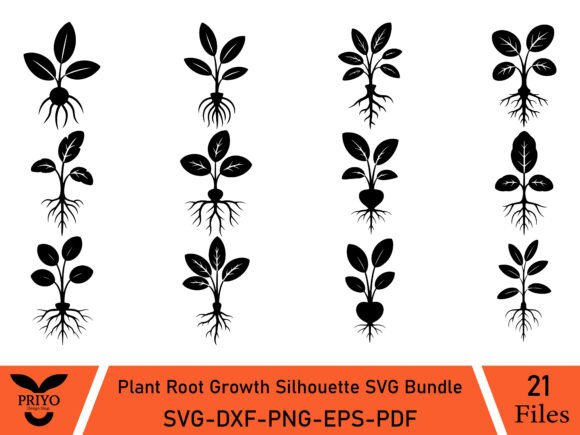
When I opened the Plant Root Growth Silhouette SVG Bundle, my first thought wasn’t “Oh, another nature motif.” It was, “This breathes.” The lines are uncluttered but intentional—thin roots tapering into fine points, branching with organic asymmetry, grounded yet open. There’s no floral fuss, no botanical labeling, no forced symmetry. Just quiet growth: deep, unseen, resilient. That makes it unusually versatile for embroidery—not as a literal illustration, but as a subtle emblem of patience, care, or quiet strength. I immediately pictured it stitched in matte black thread on an off-white linen tote bag for a local plant shop’s holiday pop-up.
Where It Shines in Real Embroidery Projects
This isn’t a design that shouts—it invites closer looking. That works beautifully for products where craftsmanship and intention matter more than flash: embroidered baby onesies (think soft gray roots on ivory cotton), minimalist pillow covers for nursery decor, or tea towels for eco-conscious kitchen brands. As a machine embroidery design, its silhouette-based structure avoids dense fill stitch areas, which means less bulk, smoother drape, and cleaner results on lightweight fabrics like rayon challis or quilting cotton.
I tested a scaled-down version on a sweatshirt mockup and found it held up well—even at 3.5 inches wide, the root tips stayed distinct without fraying or stitching distortion. On caps? Tricky, but doable if centered over the crown (not the curved front panel) and paired with light stabilizer. For embroidered patch use, it translates cleanly to merrow-edged applique—especially when backed with heat-away stabilizer for crisp edges. And for Etsy sellers or boutique owners, it adds quiet sophistication to small shop product photography: think a single root motif stitched just above the pocket of a canvas apron, styled with dried herbs and ceramic mugs.
Where to Proceed With Thoughtful Stitching
Because it relies on fine line work and delicate tapering, the Plant Root Growth Silhouette SVG Bundle demands attention to fabric and technique—not limitations, just considerations. On highly textured fabrics like terry cloth or bouclé, those thin root ends can blur or disappear mid-stitch. On stretchy knits (like jersey tees), even moderate tension may cause slight distortion unless you use cutaway + tear-away combo stabilizer and reduce stitch density slightly in your embroidery software.
Dark fabric is actually a strength here—the design reads with elegant contrast in charcoal thread on navy denim or deep olive linen. But avoid pairing it with ultra-thin fabrics like silk charmeuse without backing; the needle piercings show too easily, and fine branches may not hold structural integrity after washing. Also, skip placing it directly over seams or curved surfaces like hat brims—those subtle angles can stretch the root lines unevenly.
What It Adds to Your Handmade Product—and Your Customer’s Experience
Customers don’t buy “a root.” They buy meaning: grounding. Growth. Care. When used intentionally—as part of a personalized gift for a new parent, a therapist’s office decor item, or a wellness brand’s merchandise—the Plant Root Growth Silhouette SVG Bundle quietly elevates perceived value. It feels handmade, not mass-produced, because it doesn’t rely on trend-driven clichés. That builds trust. A buyer who chooses this over a generic leaf or flower understands subtlety—and they’ll notice (and appreciate) clean stitching, balanced thread tension, and thoughtful placement.
For craft business owners, it supports brand consistency without locking you into one aesthetic. Use it in monochrome for minimalist branding, then reinterpret it in sage-and-cream thread for spring collections. It also scales well into printable mockups—I layered it over flat-lay photos of ceramic planters and woven baskets, and it read clearly even at thumbnail size. That’s rare for silhouette-based digital embroidery files.
Practical Notes Every Embroidery Designer Should Check
- Test first on scrap fabric—especially if using textured, dark, or stretchy materials. Watch how root tips behave after trimming and washing.
- Review stitch density before hooping. If the file includes satin or fill elements (even minimal ones), confirm they’re optimized for your machine’s speed and needle type.
- Confirm hoop size compatibility. While the SVG format suggests scalability, embroidery software may impose limits—check whether your digitized version fits comfortably within standard 4x4 or 5x7 hoops.
- Inspect small details at 200% zoom in your embroidery editor. Are root ends digitized as running stitch or tapered satin? That affects clarity on fine fabrics.
- Try black-and-white mockups before finalizing thread colors. This design gains strength from tonal contrast—not color variety.
- Verify licensing before selling finished items or bundling the file with other design assets. Since the listing mentions commercial use for prints and mugs, double-check whether embroidery resale rights are explicitly included.
Final Thought: Not Just Another Graphic—A Quiet Design Choice
The Plant Root Growth Silhouette SVG Bundle won’t dominate a shelf or stop scrollers mid-feed. But it lingers. In the right context—a custom embroidered tote for a herbalist, a tiny root motif on a baby blanket hem, a subtle repeat pattern on a craft fair apron—it becomes part of a story. As a designer who’s digitized hundreds of motifs, I respect how much restraint this bundle shows. It trusts the maker. It trusts the material. And most importantly, it trusts the person who receives the finished product to feel what’s beneath the surface—just like roots do.