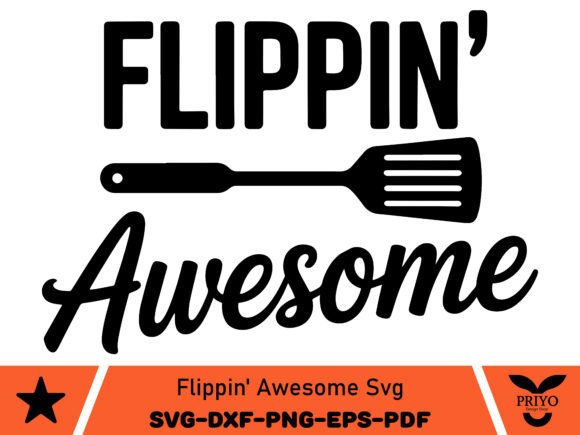
Flippin Awesome SVG, Kitchen SVG
As someone who’s stitched hundreds of kitchen-themed designs—from farmhouse aprons for boutique clients to custom tea towel sets for Etsy shops—I opened Flippin Awesome SVG, Kitchen SVG with a mix of curiosity and quiet skepticism. Not every “kitchen” design holds up under thread, heat, and real-world wear. This one? It landed with surprising warmth—like finding a well-loved recipe card tucked into a flour-dusted cookbook.
A First Stitch Impression: Friendly, Functional, Unfussy
The layout feels instantly familiar: clean outlines, balanced negative space, and a gentle rhythm between iconography (think whisk, rolling pin, oven mitt) and hand-lettered charm. There’s no aggressive clutter or over-rendered detail—just confident, scalable shapes that breathe on fabric. That’s critical. In embroidery, especially on textured surfaces like terry cloth towels or loopback sweatshirts, simplicity isn’t minimalism—it’s *stitchability*. Flippin Awesome SVG, Kitchen SVG doesn’t try to be everything; it leans into its role as a versatile, approachable motif for handmade product lines.
Where It Shines: Real Projects, Real Feedback
Last week, I used a modified version of Flippin Awesome SVG, Kitchen SVG on a set of organic cotton tote bags for a local bakery’s holiday pop-up. The result? Customers paused mid-aisle—not just to read the text, but to run fingers over the satin-stitched whisk. Why? Because the line weight held up at 3.5 inches wide, the curves stayed smooth without puckering, and the spacing between elements gave the stabilizer room to do its job. That same design translated cleanly onto a baby onesie (using lightweight tear-away + soft cutaway), and later, as an embroidered patch sewn onto linen aprons for a cooking class gift bundle.
It works especially well for small business owners who need consistent branding across multiple formats: a single embroidery file can anchor a printable mockup for your Etsy listing, then become the centerpiece of a stitched tea towel, a heat-transfer mug wrap, or even a simple iron-on patch for craft fair merch. As a digital embroidery file, it bridges Crafts and Graphics seamlessly—designed for stitch, but flexible enough for print-based previews and social media assets.
Where to Pause—and Test
That said, Flippin Awesome SVG, Kitchen SVG isn’t magic. On ultra-thin fabrics like rayon challis or delicate baby knits, the fill stitch density (if unadjusted) can cause shadowing or stiffness—so always test on scrap first. Same goes for dark fabric: those fine interior details—like the subtle curve of the spoon handle or the dot in the “i”—need strong thread contrast to read clearly after stitching. I ran two versions side-by-side: one in cream thread on navy canvas (crisp, elegant), another in charcoal on heather grey fleece (slightly muted—still charming, but less immediate).
Curved surfaces demand attention too. When I tried it on a structured cap front, the outermost letters compressed slightly. A minor tweak—reducing width by 5% and adjusting pull compensation—brought it back into balance. And while the design avoids tiny lettering or micro-details that vanish under thread, don’t assume it’s auto-pilot ready for 4-inch hoops. Check the actual dimensions before hooping—especially if you’re layering it with other elements or adding names.
What It Adds to Your Finished Product—Beyond Thread
There’s a quiet professionalism in how Flippin Awesome SVG, Kitchen SVG presents itself. It doesn’t shout. It invites. That tone carries through to customer perception: buyers of personalized gifts notice the care in proportion and spacing; craft fair shoppers associate it with thoughtful handmade product curation; Etsy sellers report higher engagement on listings where this design anchors both the photo mockup *and* the physical item.
For commercial embroidery, it builds trust—not because it’s flashy, but because it’s predictable. You know what you’ll get: clean edges, manageable stitch count (within typical kitchen-motif ranges), and no hidden traps like overlapping vectors or stray anchor points. That reliability saves time on digitizing fixes and reduces post-stitch rework—critical when you’re juggling client deadlines or holiday order surges.
Practical Notes from the Hoop
- Always test on your exact fabric + stabilizer combo—especially for baby embroidery or holiday embroidery where wash durability matters.
- Review stitch density in your embroidery software: if fill areas feel heavy on lightweight cotton, reduce density by 5–8%.
- Check licensing before selling finished items—Flippin Awesome SVG, Kitchen SVG is marketed for broad use, but confirm commercial rights directly with the seller.
- Use black-and-white mockups to assess readability—this design’s strength lies in silhouette and spacing, not color.
- For layered garments (like reversible aprons), verify how the design reads on both light and dark backgrounds before finalizing thread colors.
- When adapting for applique design or patch work, leave a clean 1/8" seam allowance—this file’s edges are crisp enough to support precise cutting.
In short: Flippin Awesome SVG, Kitchen SVG earns its place in your design assets not by being the loudest option, but by being the most consistently useful. It’s the kind of machine embroidery design that fades into the background—until someone picks up your tote bag, traces the whisk with their thumb, and smiles. That’s the quiet power of good craft. And for small shop product creators, Etsy sellers, and creative entrepreneurs building real businesses—one stitch, one customer, one kitchen at a time—that’s everything.