This Is Chicken Shit Funny Meme SVG
Let’s be real: not every funny meme translates well to embroidery. I’ve stitched hundreds of “quirky” designs for clients — from boutique aprons to baby onesies, custom trucker caps to holiday tea towels — and the moment I opened This Is Chicken Shit Funny Meme SVG, I paused. Not because it’s confusing, but because it’s *deliberately absurd*, and that kind of humor needs careful handling in thread.
I recently used it for a small-batch run of embroidered cotton tote bags destined for a local farm-to-table market stall. The vibe? Playful, unapologetically country-adjacent, with just enough edge to stand out among rows of floral monograms and rustic script. But before I even loaded the file into my embroidery software, I asked myself: Does this design hold up when reduced to 3.5 inches wide on canvas? Will the chicken’s expression survive satin stitch? And most importantly — will someone actually *buy* it as a finished product, or is it just a laugh in a digital cart?
First Impressions: Charm With Clear Boundaries
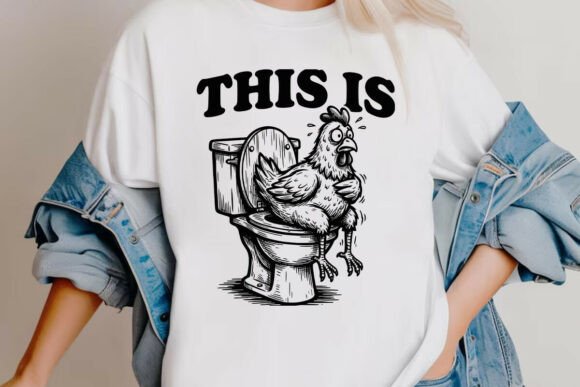
The composition is bold and centered — a cartoon chicken perched on a toilet, with clean, rounded outlines and minimal internal detail. It reads instantly at a glance, which is ideal for apparel and accessories where legibility matters more than fine art nuance. There’s no background clutter, no overlapping elements, and the lettering (“This is Chicken Shit”) uses thick, friendly sans-serif strokes — not delicate serifs or condensed fonts that vanish under dense fill stitch.
That simplicity is its strength — and its limitation. As a machine embroidery design, it avoids excessive layering, tiny loops, or micro-details that would snag or blur. That means fewer headaches with stabilizer choice and less risk of thread breaks during long runs. But it also means it won’t shine on ultra-premium items like silk pillow covers or heirloom baby blankets — not because it’s poorly made, but because its personality is loud, casual, and rooted in craft-fair energy.
Where It Shines (and Where It Stumbles)
Shines on:
- Tote bag design — especially natural canvas or medium-weight cotton duck. The shape fills the hoop cleanly, and the contrast between chicken and background pops without needing underlay overload.
- Sweatshirt embroidery — the bold lines translate well to fleece texture when paired with medium-weight cutaway stabilizer. No ghosting, no puckering, even on heavier blends.
- Embroidered patch — clean edges mean easy peel-and-stick backing or sew-on application. Great for denim jackets or festival gear.
- Holiday embroidery — think “ugly sweater” kits or gag-gift kitchen towels. It lands with timing and tone, especially alongside other lighthearted, Western- or country-themed design assets.
- Small shop product — Etsy sellers and craft fair vendors report strong engagement on listings using this as a featured digital embroidery file, especially when styled with mockups showing real fabric texture.
Use carefully on:
- Baby embroidery — while harmless, the phrase may raise eyebrows with conservative gift-givers. Consider context: a dad’s onesie? Yes. A newborn’s hospital hat? Probably not.
- Thin or stretchy fabric — like lightweight jersey or rayon challis. The design’s width and stitch density demand stability; skip it unless you’re confident with lightweight tear-away + basting techniques.
- Dark fabric — the original file appears optimized for light backgrounds. Always test thread colors — a warm cream or oatmeal works better than stark white on charcoal, and avoid pale yellows that disappear on khaki.
- Curved surfaces — like structured caps or curved pillow fronts. Distortion can flatten the chicken’s posture or compress the text. Reduce size slightly and reposition away from seams or crowns.
Design Integrity in Real Projects
What sets This Is Chicken Shit Funny Meme SVG apart isn’t technical perfection — it’s consistency of voice. In a sea of generic “cowgirl life” or “barnyard love” graphics, this design owns its irreverence without leaning into crudeness. That builds trust with customers who value authenticity over polish.
As a craft business owner, I’ve found it performs best when paired intentionally: on a sturdy canvas apron for a feed store pop-up, or as a single chest embroidery on an oversized flannel shirt sold at a music festival. It doesn’t try to be elegant — and that’s why it feels handmade, not mass-produced.
It also scales surprisingly well. At 2.75”, it reads clearly on a child’s cap. At 4.5”, it anchors a linen tea towel without overwhelming the weave. Just avoid pushing beyond 5” — the proportions start to feel cartoonish rather than charming, and stitch density can create unnecessary bulk.
Practical Designer Notes Before You Stitch
Before committing to a full production run — whether for your own handmade product line or a client’s personalized gift — do these five things:
- Run a test on scrap fabric matching your final material — especially if using textured weaves or blends.
- Check stitch density in your software. If it’s over 12,000 stitches, consider simplifying fill areas or switching some satin stitch to running stitch for breathability.
- Confirm hoop size compatibility. This design fits comfortably in a 4×4 hoop, but verify alignment if stitching near garment edges or seams.
- Review licensing. Since it’s listed under Graphics and Crafts, confirm whether commercial use (e.g., selling finished embroidered items on Etsy) is permitted — don’t assume.
- Mock it up in black and white first. If the silhouette loses impact without color, adjust thread contrast or add a subtle outline stitch.
At its core, This Is Chicken Shit Funny Meme SVG isn’t trying to be everything. It’s a focused, functional, and refreshingly honest piece of embroidery project fuel — one that works because it knows exactly who it’s for, and where it belongs. Use it with intention, test with care, and let the humor land where it’s meant to: in the hands of someone who’ll genuinely grin when they see it stitched on their favorite tote, sweatshirt, or apron.